miércoles, 2 de octubre de 2013

L10N, G11N, I18N


G11N, I18N, L10N, TRANSLATION – SURE YOU KNOW WHAT THESE MEAN? OR FEELING GILTY BECAUSE YOU NEED CLARIFICATION?

Many businesses who are in the initial stages of taking their products to new markets get confused by the terms Globalization, Internationalization, Localization and Translation.  Collectively, these terms are referred to as “GILT”, and represent all of the language and culture related processes involved in global business.   The differences between the terms are subtle, and you need not feel “guilty” if you don’t understand!  Let me try to shed some light on the subject.
First, you will often see the first three referred to by the abbreviations below:
  • G11n     Globalization
  • I18n      Internationalization
  • L10n     Localization
How were these strange abbreviations created?  They are simply the first and last letter, with the number of letters listed in between.
There are many different definitions for all of these terms, one set of definitions that I like is:
  • Globalization- Refers to a broad range of processes necessary to prepare and launch products and company activities internationally.
  • Internationalization- Developing content that is easily localizable, doesn’t include local/regional references.
  • Localization- The process of adapting a product or service to a particular language and culture.
  • Translation- The process of converting text from one language to another.
Still confused?  Let me explain by showing some specific examples of each.
Globalization
  • Refers to a broad range of processes necessary to prepare and launch products and company activities internationally.
This includes addressing the business issues associated with launching a product globally, such as integrating localization throughout a company after proper internationalization and product design.   It goes beyond localization and includes the revision of business processes, management procedures and even the adaptation of marketing tools, among other initiatives.
Internationalization
  • Developing content that is easily localizable, doesn’t include local/regional references.
One company that is successful at Internationalization is Ikea.  In fact, they put so much work into developing generic content for all markets that their instructions usually require almost no localization effort at all!  As you can see by the example below, they use graphics without text
embedded so it can easily be used for all markets.
Localization
  • The process of adapting a product or service to a particular language and culture.
Some products don’t require much in the way of localization.  Others require a major localization effort to be successful in other markets.  Take, for example, the game Trivial Pursuit.  Many of the questions are specific to American pop culture.  Sure, you could translate this game, but how well would a game with questions about 1920’s baseball teams and dance moves like the “Twist” and the “Jitterbug” sell in say, Brazil?  Perhaps questions about Soccer and the Samba would be more appropriate for that market, and full Localization would be required.
Translation
  • The process of converting text from one language to another.
That is the most straightforward way of defining translation in a scientific manner.  A lot more can be said about the topic and its manifold faces, such as the way it can be divided into different subjects, for example, literary translation, software translation, and even bad translation!Nevertheless, it is the concept of translation that has become more mainstream than any of the other concepts described above and even more so in today’s world with the widespread appeal of funny (and strikingly bad) translations.
In summary, though at first sight the concepts might be hard to grasp, all four concepts are very logical and deserve their own space in today’s globalized world. You will continue to hear about these, so it is practical that you gain a basic understanding. And no, it is not Unbelieveable!


REF: http://blog.adaquest.com/2011/09/23/g11n-i18n-l10n-translation-%E2%80%93-sure-you-know-what-these-mean-or-feeling-gilty-because-you-need-clarification-2/

lunes, 9 de septiembre de 2013

20 British Words that mean something totally different in American English

Here in the United States, we speak the same language as our ye old predecessors in Great Britain, but we don't always speak it the same way. So, we asked our oh-so British receptionist, Ryan Lovett, to give us a crash course in some of the more notable discrepancies.
Here are 20 words (along with some accompanying Bigstock images) that have pretty different meanings in Great Britain than they do in the U.S. 

1. Jumper 

2. Trainer 

3. Pants

4. Bird

5. Bog

6. Rubber

7. Braces

8. Trolley

9. Chips

10. Coach

11. Biscuit

12. Shag

13. Dummy

14. Lift

15. Hooker

16. Flannel

17. Football

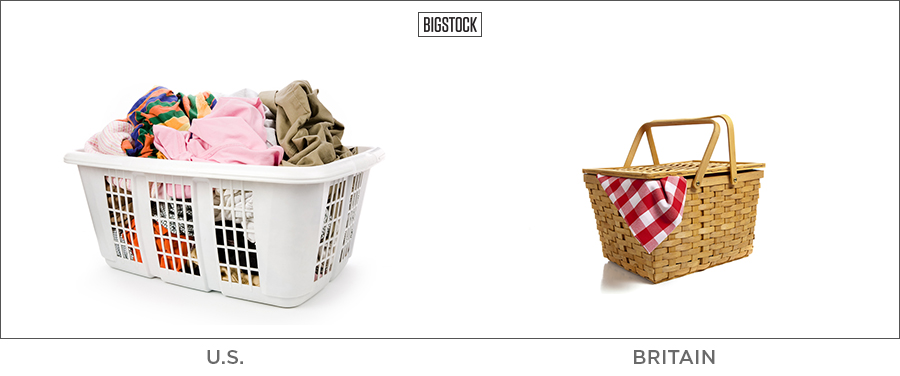
18. Hamper

19. Vest

20. God Save the Queen! 

Ryan would like to thank his office minions in helping him with this in-depth report.

http://bigstockblog.squarespace.com/blog/20-british-words-that-mean-something-totally-different-in-the-us

jueves, 29 de agosto de 2013

E-mail error ends up on road sign - BBC

E-mail error ends up on road sign

Mis-translated bilingual road sign
The English is clear enough to lorry drivers - but the Welsh reads "I am not in the office at the moment. Send any work to be translated."

When officials asked for the Welsh translation of a road sign, they thought the reply was what they needed.
Unfortunately, the e-mail response to Swansea council said in Welsh: "I am not in the office at the moment. Send any work to be translated".
So that was what went up under the English version which barred lorries from a road near a supermarket.
"When they're proofing signs, they should really use someone who speaks Welsh," said journalist Dylan Iorwerth.
 It's good to see people trying to translate but they should really ask for expert help
Dylan Iorwerth, Golwg magazine
Swansea council got lost in translation when it was looking to halt heavy goods vehicles using a road near an Asda store in the Morriston area.
All official road signs in Wales are bilingual, so the local authority e-mailed its in-house translation service for the Welsh version of: "No entry for heavy goods vehicles. Residential site only".
The reply duly came back and officials set the wheels in motion to create the large sign in both languages.
The notice went up and all seemed well - until Welsh speakers began pointing out the embarrassing error.
Welsh-language magazine Golwg was promptly sent photographs of the offending sign by a number of its readers.
Site of wrongly translated sign
The sign was lost in translation - and is now missing from the roadside
Managing editor Mr Iorwerth said: "We've been running a series of these pictures over the past months.
"They're circulating among Welsh speakers because, unfortunately, it's all too common that things are not just badly translated, but are put together by people who have no idea about the language.
"It's good to see people trying to translate, but they should really ask for expert help.
"Everything these days seems to be written first in English and then translated.
"Ideally, they should be written separately in both languages."
A council spokeswoman said: "Our attention was drawn to the mistranslation of a sign at the junction of Clase Road and Pant-y-Blawd Road.
Other confusing signs
"We took it down as soon as we were made aware of it and a correct sign will be re-instated as soon as possible."
The blunder is not the only time Welsh has been translated incorrectly or put in the wrong place:
• Cyclists between Cardiff and Penarth in 2006 were left confused by a bilingual road sign telling them they had problems with an "inflamed bladder".
• In the same year, a sign for pedestrians in Cardiff reading 'Look Right' in English read 'Look Left' in Welsh.
• In 2006, a shared-faith school in Wrexham removed a sign which translated the Welsh for staff as "wooden stave".
• Football fans at a FA Cup tie between Oldham and Chasetown - two English teams - in 2005 were left scratching their heads after a Welsh-language hoarding was put up along the pitch. It should have gone to a match in Merthyr Tydfil.
• People living near an Aberdeenshire building site in 2006 were mystified when a sign apologising for the inconvenience was written in Welsh as well as English.

domingo, 14 de julio de 2013

9 Common Word Mistakes

The following is an excerpt from Bill Walsh's new book Yes, I Could Care Less.Copyright © 2013 by Bill Walsh.
If you’re using “I could care less” and “My head literally exploded” because you’re trying to affect a breezy manner, or you’re simply dashing off a casual e-mail, or you’re a learned linguist trying to show how just-folks you are, or your head literally exploded, go right ahead. (In the latter case, I can totally understand why you could care less.) If you’re writing something of some importance and choosing those words because you don’t know what words mean, I will helpfully point out that you may be sending a message you’d rather not send.
In the coming chapters, I’ll argue for maintaining some tiny distinctions and rejecting some fairly well-established usages in the name of distracting as few readers as possible. I’ll even argue for some new usages because the traditional ones have become so antique as to be distracting. But there’s no pleasing everybody, and so we have to pick our battles in the war on distraction.
Could care less and the non-literal literal are just two of the evergreens in the picky-about-the-language biz, disputed or evolving usages that separate the eager from the hesitant when it comes to language change. It’s tempting to treat all these disputes as one and the same, as I just sort of did (or “one in the same,” as people who like to be wrong would say), but that’s an oversimplification. These disputes run the gamut from outright errors (your for you’re) to errors on which some are giving up (inferfor imply) to errors gaining traction (hone in for home in, straight-laced for strait-laced) to useful evolution in progress (bemused for “wryly amused”) to useful evolution that’s well established (host as a verb, gender for sex) to the displacement of antiquated words (careen for career) to the rejection of unfounded superstitions (hopefully as a sentence adverb). And I’ve probably missed a category or two.
It’s unlikely that any two people will display identical linguistic fingerprints—personal stylebooks, you could say—as they tick off their stances on these questions. As we saw with literally, even the learned linguists have their aversions.
Some will say these issues are shibboleths—questions on which the right answer establishes you as a member of a select group. That’s true in a sense, but you won’t catch me pronouncing shibboleth with such disgust that spittle flies from my mouth. A shibboleth isn’t necessarily a bad thing. For instance, although there’s no longer any reason for newspaper copy editors to use the spellings hed for head-as-in-headline andlede for lead-as-in-lead-paragraph, I would be wary of hiring a copy editor who was not aware of those spellings. The shibboleth can be a shortcut, the tip of a knowledge iceberg. The select group it’s putting you in could be the group of people who know what the hell they’re doing.
Reject whom in many of its traditional roles if you like (I do), but if you’re a native speaker of English and you tell me you had no idea the word even existed, I’m going to make some inferences about how smart you are. The same is true, to varying degrees, about many of the disputes I discuss in this chapter and this book.
In the Internet age, when you’re likely to “meet” far more people than you actually meet, the way you use language will be the only clue most of those people have about your intelligence and your capabilities. So it’s a good idea to have a working knowledge of the flash points. What follows is a by-no-means-comprehensive survey.
bemused
The established meaning is basically “bewildered.” The new meaning, the one you generally hear nowadays, is just starting to join the old one in dictionaries, and I have to concede its utility. Whereas there are plenty of ways to say bewildered, dazed, confused or distracted, I can’t think of a single synonym for bemused as in mildly and wryly amused. You’re not guffawing, but you are wearing a little grin. Perhaps you’re a little confused as well—you’re not quite sure why your new album is charting in Japan while it’s being ignored at home, but it makes you smile.
Here’s where I get into trouble: I like this evolution and consider it useful, but I reject the usage for now. It’s just too new. Too many people actually know what the word is supposed to mean. If the dictionaries, which are inherently descriptive, haven’t recognized a usage, it’s not a good idea to get out in front of them. If the books don’t describe, you must proscribe.
comprise
My country comprises 50 states. Or is composed of 50 states. Or consists of 50 states. Those 50 states constitute my country. If all those com- and con- words are too confusing, just say the country is made up of 50 states, or 50 states make up the country. I hope I’ve provided enough choices to make it clear that there’s no need to add is comprised of to the menu. Even if the phrase has been used by notables from Lord Byron to Donald Trump.
disinterested
Uninterested is readily available, at popular prices, so just use it already and savedisinterested for phrases such as a disinterested observer, in which it means impartial.
enormity
The group of people who know that the word means great evil or wickedness continues to shrink, but the enormousness of their potential laughter at something like “the enormity of this honor” is reason enough to hold on to the distinction. The word will get plenty of exercise, often in references where it could refer to both evil and magnitude, such as the enormity of the 9/11 terrorist attacks.
gauntlet, gantlet
To review: You throw down and/or pick up the gauntlet, which is a glove; you run the gantlet, which is a narrow lane formed by two rows of people intent on punishing or otherwise tormenting you. The similar spellings and similarly medieval natures of the two words have caused them to merge over time, but careful writers maintain the distinction. It’s nice to leave room to talk about picking up the gauntlet and running the gantlet, as opposed to picking up the gauntlet-as-in-glove and running the gauntlet-as-in-lane-of-torment.
graduate
When I hear “I graduated college,” I want to answer “No, you didn’t.” The expression evolved from was graduated from to graduated from, and it is evolving again, but—at least for now—you call your education into question if you omit the from
insure
You buy car insurance to ensure you don’t go broke in the event of a crash andassure yourself you’re doing the right thing.
lay and lie
In actual writing if not casual conversation, I lay my glasses on the nightstand before I lie down. The past tense of lie, confusingly enough, is lay: I lay in bed for half an hour before I realized it was a workday. I’ve heard rumblings about crossing this off the list of things to worry about, but that would be a downright futuristic move. Literate people overwhelmingly observe the distinction.
strait-laced
That’s the spelling, not straight-laced. The latter is increasingly common, but a lot of people also misspell supersede and stratagem and minuscule and sherbet, too. I prefer correct spelling. Maybe it’s just me.